Rich results are Google search results that show more than a title, URL, and description, such as ratings, prices, images, or recipe details. Google generates them from structured data on the page. Whether a page is shown this way is decided automatically.
How do rich results come about?
Google reads structured data from a page’s source. It recommends JSON-LD, and Microdata and RDFa also work. Its search gallery lists the supported features, among them Article, Breadcrumb, Carousel, Event, Job posting, Local business, Product, Recipe, Review snippet, Video, Discussion forum, and Q&A.
The markup has to meet the guidelines for its type and contain the required properties. Google does not guarantee the display and says the actual appearance in search might be different. Most features can be previewed with the Rich Results Test.
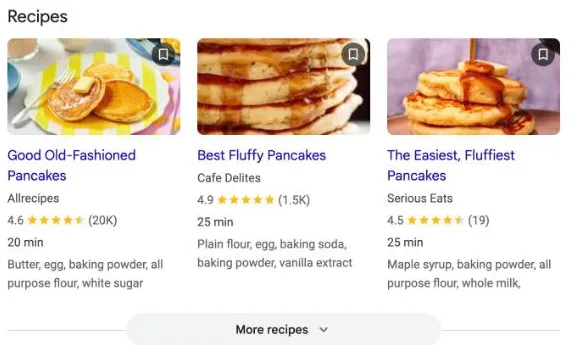
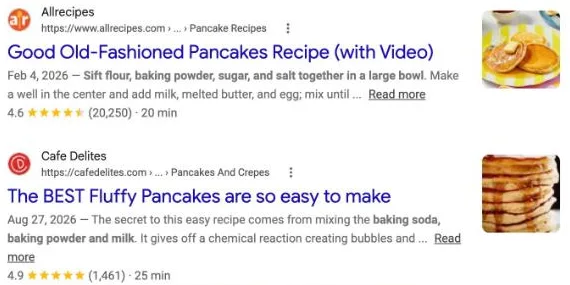
Example
Markup for a product page with rating and price:
<script type="application/ld+json">
{
  "@context": "https://schema.org",
  "@type": "Product",
  "name": "Hiking backpack 30 L",
  "aggregateRating": { "@type": "AggregateRating", "ratingValue": "4.6", "reviewCount": "128" },
  "offers": { "@type": "Offer", "price": "89.90", "priceCurrency": "USD" }
}
</script>
Whether Google then shows stars and a price is up to Google.
Rich results can disappear
Google also retires result types. According to its documentation updates, FAQ rich results no longer appear in Google Search since May 7, 2026. Other features Google has phased out are listed in the timeline below. The list of supported types is worth comparing against the current documentation from time to time.
- Google introduces the improved sitelinks search box. It sends queries straight to the site's own search pages.Source: developers.google.com
- Google announces it will remove the “mobile-friendly” label from mobile results, as 85% of pages already meet the criteria.Source: developers.google.com
- Google announces the end of data-vocabulary.org. Markup in this format is to lose rich result eligibility from April 6, 2020.Source: developers.google.com
- Google moves the end of data-vocabulary.org support to January 29, 2021.Source: developers.google.com
- Google announces that from May 2021, non-AMP pages will also be eligible for the mobile Top Stories feature.Source: developers.google.com
- New timing from mid-June 2021. AMP is then no longer required for Top Stories, and Google stops showing the AMP badge.Source: developers.google.com
- Google removes the related: search operator from its documentation, as it is no longer supported.Source: developers.google.com
- Google limits FAQ rich results to well-known government and health websites. How-to rich results are shown on desktop only.Source: developers.google.com
- How-to rich results are no longer shown on desktop either. Google calls the result type deprecated.Source: developers.google.com
- Google removes the host group element from its visual elements gallery, as it no longer appears in search results.Source: developers.google.com
- Google removes the guidance for the limited-access video carousel after the markup proved not useful at scale.Source: developers.google.com
- The Notes experiment, which let users add notes to search results, has ended. Google removes its documentation.Source: developers.google.com
- The cache: search operator no longer works. Google removes its documentation.Source: developers.google.com
- The cached link is no longer available in search results. Google keeps noarchive only as a historical rule.Source: developers.google.com
- Google announces that it will remove the sitelinks search box worldwide from November 21, 2024. Other sitelinks remain.Source: developers.google.com
- Google removes the sitelinks search box documentation and archives the nositelinkssearchbox rule.Source: developers.google.com
- Mobile search results no longer show breadcrumbs in the visible URL, only the domain. They remain on desktop.Source: developers.google.com
- Google announces it will phase out several structured data features, including Book Actions, Course Info, ClaimReview, Estimated Salary, Learning Video, Special Announcement and Vehicle Listing.Source: developers.google.com
- Google removes the documentation for course info, estimated salary, learning video, special announcement and vehicle listing. These types no longer appear in results.Source: developers.google.com
- Google phases out the practice problem and dataset types in Search. For Book Actions, Google withdraws the deprecation notice.Source: developers.google.com
- FAQ rich results no longer appear in Google Search. Google announced this in its changelog entry of May 8, 2026.Source: developers.google.com
- Google removes the documentation for the FAQ rich result.Source: developers.google.com
- Google now sends users directly to AMP pages on the publisher's own host. The AMP viewer, AMP Cache and signed exchanges are no longer involved.Source: developers.google.com
Only backed by press or social media, so not listed as events. Author photos (Authorship) disappeared in June 2014 according to Search Engine Land, and Authorship display in August 2014 according to Search Engine Watch. Google's Search Liaison confirmed the end of the cached link on X on February 1, 2024 (per 9to5Google). According to Search Engine Land, continuous scroll ended on desktop from June 25, 2024, with mobile following in later months. Last checked: .
Common mistakes
- Marking up content visitors cannot see. Google asks for markup of visible content only. A violation can lead to a manual action, after which the page loses its eligibility for rich results. Ranking in regular web search is not affected.
- Missing required properties. According to Google, items without all required properties are not eligible for rich results.
- Page blocked for Googlebot. Pages with structured data must not be blocked through robots.txt,
noindexor other access controls. - Misleading or irrelevant markup. Fake reviews or content unrelated to the focus of the page violate Google’s guidelines.
FAQ
What is a rich results test? A Google tool that shows which rich results can be generated from the structured data on a page.
Does correct markup guarantee a rich result? No. The type’s guidelines must be met as well, and Google decides per query whether to show it.
Sources
- Structured data markup supported by Google Search (search gallery) - Google Search Centraldevelopers.google.com
- Introduction to structured data markup - Google Search Centraldevelopers.google.com
- Documentation updates - Google Search Centraldevelopers.google.com
- Introducing Rich Snippets – Google Search Central Blog (May 12, 2009)developers.google.com
- General structured data guidelines – Google Search Centraldevelopers.google.com
Last updated: